slutty branding: the essay on drawing your line

Brought to you by The Art Of Positioning Podcast
-
Last weekend some girlfriends and I had a slutty day. We got together had an innuendo-filled Saturday brunch, then went out in the evening to a rooftop bar and wore outfits we’ve been dying to wear just for shits and giggles.
Now, morning after one of the girls messaged me about my plan for the day, to which I stoically (read: boringly) replied, I’m about to dig into the next issue of the newsletter.
And the conversation went like:
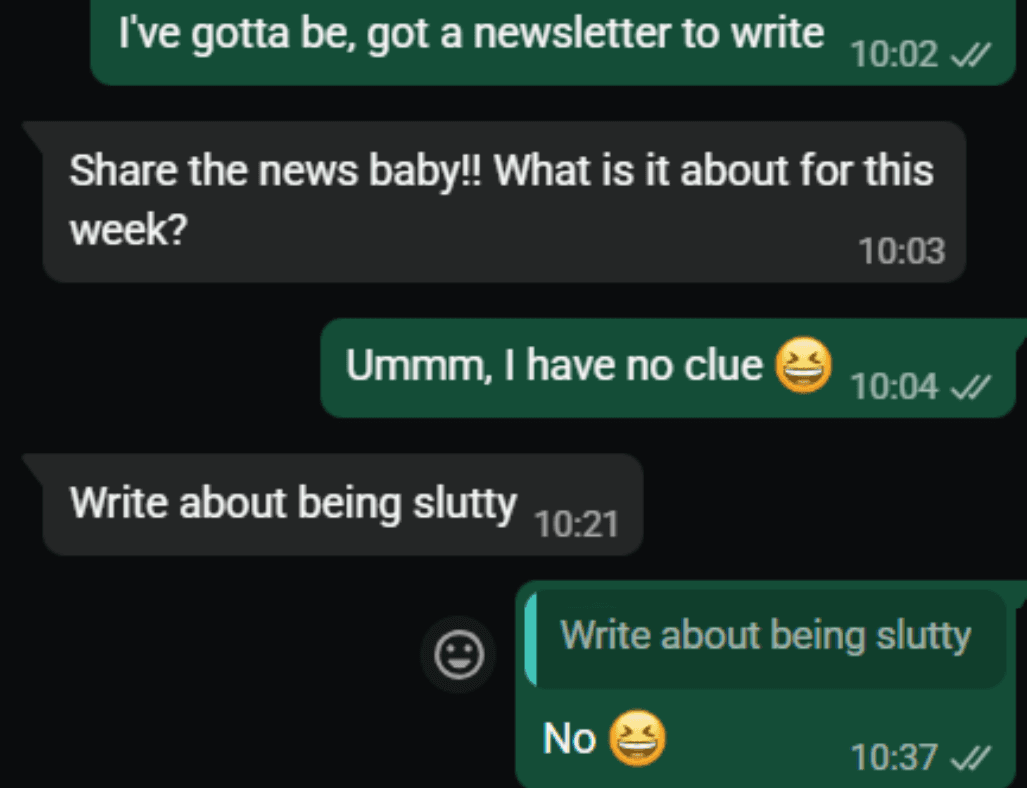
A few minutes later, though, I remembered the topic I had penciled in a few weeks ago as something that I haven’t seen covered: When to offend. What’s the line? How do we push the line…without destroying what we’ve built?
And dudes, when I saw the rough overlap, I kid you not, I was side-eyeing the universe going - Alright, I see you.
When is it okay to offend?
So, what is that line? Is there even a line?!
Yes, there is. And for me it comes down to one question: is this an identity shift, or a campaign shift?
Identity is the thing you’re known for, and if you’ve been around for a minute whether you like it or not you’ve become associated to something in your audiences mind, it’s up to you if you’ve directed that or not.
A campaign is taking the same stance and coming at it from a different angle.
👇
-
You shake hands. You're excited. You've both got ideas, big plans, and every reason to think it'll work.
Then one person starts doing more than the other.
Someone stops saying what they actually think.
Decisions get made without a proper conversation.
And before anyone calls it a problem, the business is already pulling apart.
Scherrie L. Prince is a trial attorney. Her own first business ended on a handshake with nothing written down, and her partner signed his share over to his wife, who then walked in and introduced herself as the new partner. Ivan Vickers has his own version of that story, and 400 odd startups behind him since.
So we got the two of them on for the stuff people skip while they're busy being excited.
"Wrecked on a Handshake" is out now on this The Art of Positioning Podcast episode - listen here.
-
What happens when a brand crosses its own line?
Dropping something that goes against that entire identity and what you’ve become known for crosses that line.
Like Bumble in 2024.
Bumble’s identity: The safe place for women
The move: A bold anti-celibacy message reading “thou shalt not give up on dating and become a nun.”
Basically, it led people to question what the brand stands for in their minds.
(It performed differently in UK vs US markets, which is a whole other lazy move. Nothing should be copy-pasted across markets, and they had enough funds to not make that kind of mistake.)
And once you start questioning that it’s the equivalent of a rebrand, there’s the lost trust (are we still going to have the experience? are they still going to have our backs?), lost loyalty (well, let’s try a different XYZ that is at least consistent in what they stand for), and lost market share.
Interestingly enough, that celibacy campaign was a part of a broader rebrand, so it wasn't one billboard going rogue; it was signed off as the direction.
-
Speaking of rebrands, Inc Magazine ran a piece last month where I was the expert on exactly that. When a rebrand is the answer, and when it's lipstick on a pig.
-
Pushing the line without crossing it
Here you’re staying true to the overall stance the business/brand holds, but you’re tackling it from a different angle.
And I highly *ucking encourage this, it keeps your business at the forefront, it lets you cater to fresh audiences, it lets you test out different messaging and ideas.
SURREAL and Lovehoney had a fun campaign last year bringing together two unlikely things: cereal and adult toys. They named the range ”Dild-O’s”. Tee-hee
SURREAL has built their image and identity from the get-go as a brand that’s tongue-in-cheek, having fun with what they do, never taking themselves too seriously, but never at the customers' expense. (I talk about the parts that make up the whole of SURREAL in this post.)
And dudes, they freaking sold out on both sites in under a week!
Now imagine if it was Corn Flakes and a similar adult toy brand.
Dr. John Harvey Kellogg created Corn Flakes (a bland food) to promote digestive health and… discourage desire and unsavory activities, ahem ahem.
The brand has never indicated anything else, so suddenly dropping that kind of move would lead to the same questioning as Bumble on a much bigger scale.
This shows up closer to home than an international ad campaign:
Say you’re writing posts that lend to one extreme opinion after another.
Yeah, you’ll have a viral post, but to what extent?
As soon as someone follows or goes down the rabbit hole of whiplash-ville they won’t have anything consistent to hold in their mind - so they forget your name.
How far can you actually push it?
Get super clear on your values and stance.
In the last Mob Archive issue, I shared how to surface your real values with 2 tests.
Ones that go beyond surface-level BS. Ones that you’d be willing to get uncomfortable about.
For me, having the word slutty associated with the brand doesn’t bother me in the right context.
The way I read the word is allowing yourself to be fully you and not giving a damn about the response a) because we only have one go at life, and b) because it fits perfectly with two of the brand values:
Audacity: The bravery to do the thing that makes your stomach drop, in the face of the temptation to sound/act/be like others.
Defiance: There are enough templates and “shoulds” out there. Defiance is refusing the standard answer, even when the standard answer would do the job ‘fine’ along with every other ‘fine’.
It’s that pushback on industry rules.
It’s that we won’t do the safe ‘standard’ thing.
So, where’s your line?
If you’ve gone through the last newsletter and made your values clear and defensible, the next step is to ensure that they, and your overall stance, match how your brand shows up.
This comes from your conversations; look at:
Your last 5-10 inquiries. What were the words they used to describe you? Why did they come to you specifically?
Your recent referrals. How were they referred? Specific wording here!
Your reviews. What do they mention? How do they describe the business/the experience beyond what got done?
What keeps showing up across all 3 areas?
Then finish this line:
People expect us to ____________.
For Bumble, we can say: have women’s backs.
For SURREAL, we can say: never take themselves too seriously.
Okay, that’s your promise.
Break that, and you’ve crossed the line, and you’re breaking trust.
Stay true to it while surprising the heck outta people, then you’ve got a campaign.
It’s surprise vs contradiction. The first is a badass way to stay top of mind. The second costs ya.
So, what’s your promise?
🦘 B